Exhausted, Anxious, and Empty? The Definitive 4-Step Neuro-Psychological Blueprint to Reverse Burnout and Reclaim Your Mental Edge
Summary of this Article:
This comprehensive guide provides an actionable, evidence-based psychological framework to overcome burnout syndrome and rapidly restore mental resilience. Blending clinical insights from institutions like Harvard Health with practical lifestyle design, it outlines the neurological mechanics of burnout, a 4-step recovery protocol, and high-impact micro-habits to reclaim your cognitive sovereignty and professional vitality.
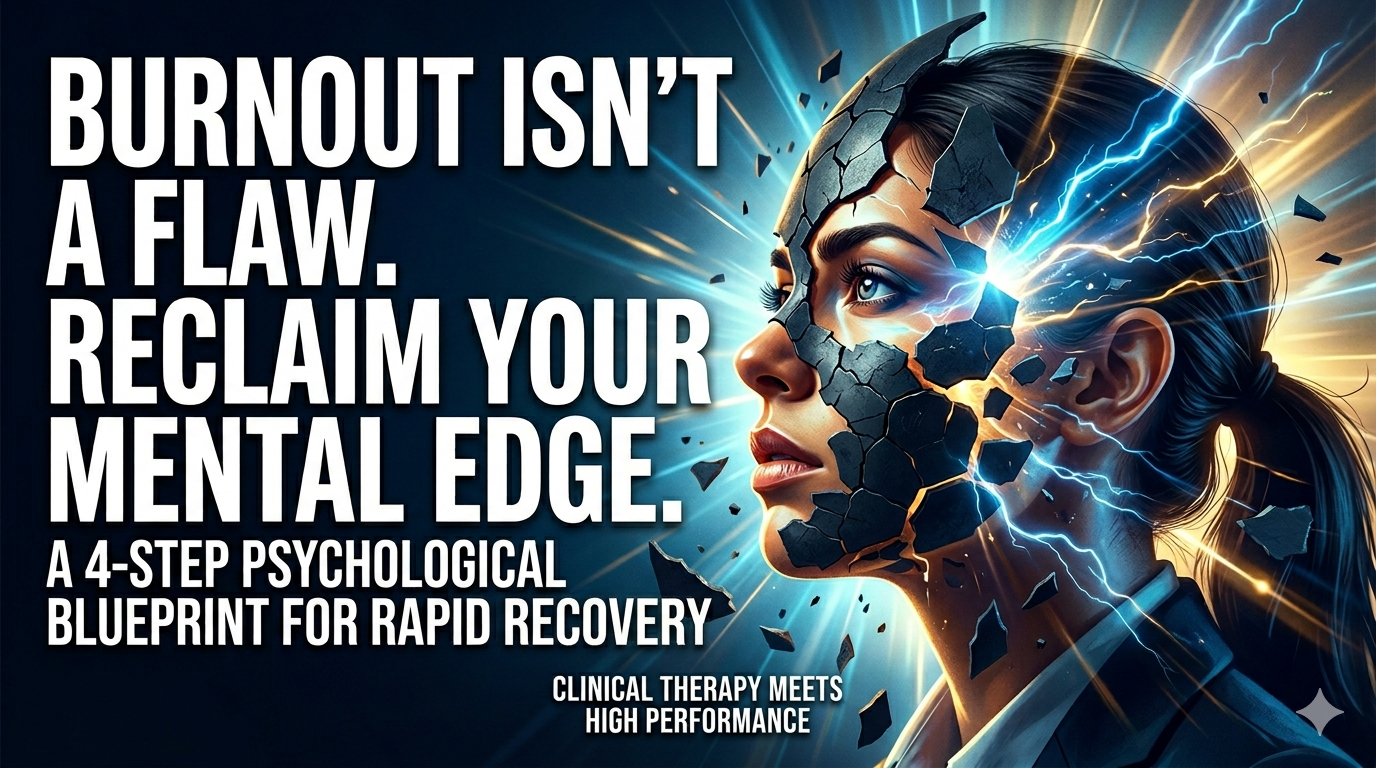
We live in a culture that mistakes chronic exhaustion for ambition and systemic depletion for a work ethic. If you woke up this morning feeling like a hollow shell of your former productive self—dread clinging to your chest before your feet even hit the floor—you aren’t lazy, and you haven’t lost your talent. You are experiencing Burnout Syndrome, a state of vital exhaustion so profound that the World Health Organization (WHO) officially classified it as an occupational phenomenon in its ICD-11.
This guide is your clinical yet deeply human roadmap to transitioning from a state of survival to cognitive and emotional sovereignty. By understanding the neurological mechanics of a fried nervous system and implementing a structured, evidence-based recovery protocol, you can rapidly reset your baseline and build an unshakeable psychological moat around your well-being.
Key Takeaways: Your Recovery at a Glance
Before diving into the deep science and therapeutic frameworks, here are the non-negotiable pillars of reversing burnout:
- Acknowledge the Neurobiology: Burnout physically alters your brain architecture (amygdala enlargement, prefrontal cortex thinning); recovery requires physiological intervention, not just “positive thinking.”
- Enforce Cognitive Offloading: Radically ruthlessly cut non-essential cognitive loads immediately to allow your nervous system’s sympathetic branch to disengage.
- The “Double-No” Boundary Rule: Protect your energy by establishing clinical boundaries at work and in relationships—treating your time as a finite, high-value asset.
- Somato-Respiratory Reset: Use physiological sighs and structured micro-breaks to down-regulate high-beta brainwave activity throughout the day.
Section 1: The Hidden Anatomy of Burnout—Why You Can’t Just “Sleep It Off”
When your mental battery hits zero, the conventional advice is usually a well-meaning but utterly ineffective platitude: “Just take a weekend off or go to a spa.” If you are dealing with true burnout, this advice is akin to putting a band-aid on a gunshot wound.
According to pioneering research published by Harvard Health Publishing, chronic, unmanaged stress triggers a sustained flood of cortisol and adrenaline. Over time, this hyper-activation of the Hypothalamic-Pituitary-Adrenal (HPA) axis doesn’t just make you tired—it structurally remodels your brain. Neuroimaging studies reveal that prolonged burnout leads to an enlarged amygdala (the brain’s fear and emotional center) and a noticeable thinning of the prefrontal cortex, which governs executive function, decision-making, and emotional regulation.
This is why you feel irritable, completely detached (depersonalization), and incapable of completing tasks that used to take you twenty minutes. You are dealing with a profound neurochemical deficit. To recover, we must stop treating burnout as a character flaw and start treating it as a legitimate physiological injury.
Section 2: Clinical Matrix—Burnout Stages vs. Targeted Therapeutic Interventions
Recovery requires a precise diagnosis of where you currently stand on the depletion spectrum. Applying the wrong therapy at the wrong stage can lead to further frustration and failure.
The table below synthesizes data from structural clinical frameworks to help you self-assess and deploy targeted interventions immediately.
| Burnout Stage | Primary Neuro-Psychological Symptoms | Dominant Nervous System State | High-Impact Therapeutic Intervention |
| Stage 1: Chronic Friction | Hyper-vigilance, high anxiety, “wired but tired” phenomenon, perfectionism spikes. | Sympathetic Dominant (Fight or Flight) | Cognitive Offloading & Somatic Down-Regulation: Somatic tracking, Box breathing ($4-4-4-4$), rigorous schedule pruning. |
| Stage 2: Depersonalization | Cynicism, emotional detachment from work/loved ones, profound loss of empathy. | Dorsal Vagal Shift (Freeze/Numbing) | Radical Boundary Restructuring: The “Double-No” protocol, professional decoupling, Acceptance and Commitment Therapy (ACT) values alignment. |
| Stage 3: Functional Collapse | Absolute cognitive fatigue, brain fog, executive dysfunction, complete physical depletion. | Systemic Burnout (HPA-Axis Dysregulation) | Clinical Sabbatical & Neural Regeneration: Total sensory fasting, low-inflammatory nutrition, intensive professional mental health therapy. |
Section 3: The 4-Step Psychological Therapy Framework to Rebuild Your Mental Moat
To transition from functional collapse back to peak cognitive performance, you must execute a systematic, step-by-step psychological protocol. This framework borrows heavily from Cognitive Behavioral Therapy (CBT), Dialectical Behavior Therapy (DBT), and Somatic Psychology.
Step 1: Somatic De-escalation (Calming the Hyper-Aroused Brain)
You cannot think your way out of a burning house, and you cannot reason your way out of a fried nervous system. When you are deeply burned out, your sympathetic nervous system is trapped in a perpetual loop of fight-or-flight. Step one is entirely physiological.
- The Physiological Sigh: Developed by neuroscientists, this is the fastest way to reduce autonomic arousal in real-time. Take two quick inhales through your nose (one deep, followed immediately by a sharp top-off inhale), then a long, slow, exhaled sigh through your mouth. Repeat this 3 to 5 times.
- Somatic Tracking: Spend 5 minutes morning and night focusing purely on physical sensations in your body without judging them. Notice the tightness in your chest or the tension in your jaw. Acknowledging these somatic markers safely breaks the brain’s internal panic loop.
Step 2: The “Double-No” Boundary Protocol
Burnout is almost always a disease of boundary failure. If you are a high-achiever in the corporate, financial, or healthcare sectors, you likely have an overdeveloped sense of responsibility. You must learn the art of the clinical refusal.
- The Rule of Two Negations: For every new commitment or project you accept over the next 30 days, you must explicitly say “no” to two existing low-value commitments or domestic tasks.
- Professional Decoupling: Reframe your relationship with your career. Your output is a commoditized skill set you trade for capital; it is not your intrinsic human worth. When you log off at 5:30 PM, your mental desktop must be as completely clear as your physical one.
[New Request] ---> Check Capacity ---> If Yes: Must Drop 2 Existing Micro-Tasks
                                  ---> If No: Apply Polite Clinical Refusal
Step 3: Cognitive Restructuring via Acceptance and Commitment (ACT)
When burned out, our inner critic goes into overdrive, telling us we are failing, slipping behind, or losing our edge. We use ACT to fundamentally alter our relationship with these intrusive, exhausting thoughts.
- Defusion Techniques: Instead of thinking, “I can’t handle this workload anymore, I’m ruined,” reframe it to: “I am noticing the thought that I am feeling overwhelmed by this workload.” This subtle linguistic shift creates a vital psychological buffer zone between your core identity and your transient emotional states.
- Value Realignment: Burnout often happens not just because we are working too hard, but because we are working on things that completely contradict our core personal values. Identify your top three core life values (e.g., Autonomy, Health, Deep Connection) and measure your current calendar against them. If there is a massive misalignment, a strategic pivot is required.
Step 4: Dopaminergic Fasting and Neural Regeneration
Modern corporate environments are optimized to exploit your dopamine pathways—Slack notifications, urgent emails, and constant fires to put out create a chaotic, highly fragmented state of mind.
- The Digital Sunset: Turn off all work-related devices at a fixed, immutable time every evening. No exceptions.
- Monotropic Focus: Multi-tasking is a psychological myth that accelerates cognitive fatigue. Force yourself to work in deeply focused, single-task blocks (such as the Pomodoro technique) and completely close all unrelated browser tabs. Give your prefrontal cortex the space to breathe and focus on one variable at a time.
Section 4: What the Global Economic & Health Leaders Say About the Burnout Epidemic
If you still feel guilty about slowing down to heal your mind, consider the macro-economic and clinical reality. This is not a personal weakness; it is a global public health crisis.
Data tracked by Bloomberg highlights that chronic workplace stress and burnout cost the global economy over $322 billion annually in lost productivity, absenteeism, and high employee turnover. Major financial institutions and elite medical networks are slowly beginning to realize that pushing talent to the brink of physical and mental collapse is a losing game with catastrophic ROI.
“Burnout is not a badge of honor. It is a lagging indicator of an unsustainable life design. The most resilient professionals are not those who never stop, but those who possess the profound psychological maturity to rest, reset, and recalibrate before their body forces them to do so.”
Conclusion: Take Back the Reins of Your Mind Today
Recovering from burnout is not an overnight event; it is a conscious, structured reclamation of your life. Your mind, your creativity, and your peace are far too valuable to sacrifice on the altar of perpetual busyness. You have the clinical tools, the physiological insights, and the step-by-step psychological framework right in front of you. Now, it’s time to act.
📢 Your Next Action Step
Do not let this be just another article you read and forget. Take a stand for your health right now. Pick one boundary you will ruthlessly enforce today—whether that is turning off your work notifications by 6:00 PM, saying no to an extra project you don’t have the bandwidth for, or practicing 3 minutes of physiological sighs during your lunch break.
Commit to it, protect it like your life depends on it—because your mental health absolutely does. If you found this guide valuable, bookmark it as your mental safety net, and share it with a colleague or friend who is quietly drowning in chronic stress. Let’s heal together.