The “Nothing to Lose” Mindset: How Tycoons Turn Scarcity into Billions
The “Nothing to Lose” Mindset: How Tycoons Turn Scarcity into Billions
Scarcity isn’t a barrier to success; it’s a powerful catalyst that activates our brain’s most potent problem-solving capabilities. Global business leaders and behavioral scientists agree that a lack of resources, connections, or time can be the ultimate trigger for immense wealth creation. This guide explores the legendary mindset of those who transformed extreme deficits into multi-billion dollar fortunes and provides a practical framework for adopting it.
Key Takeaways
Understand the core principles of leveraging scarcity for success.
- The Scarcity Paradox: Resource limitations sharpen focus and enhance problem-solving by engaging the brain’s prefrontal cortex.
- Focused Execution: Successful individuals use scarcity-driven intense focus to eliminate distractions and implement smart strategies.
- Resourceful Growth: Overcoming financial scarcity involves assessing human capital and maintaining mental well-being, not just perseverance.

The Science of Scarcity: How “Having Nothing” Becomes Your Advantage
Neuroscience and economics demonstrate the significant cognitive impact of scarcity.
Research by behavioral economists like Sendhil Mullainathan and psychologists Eldar Shafir highlights how scarcity fundamentally alters human cognition. While abundance allows the brain to operate in a relaxed mode, limited resources compel it into a state of hyper-focus, directing all energy toward immediate problem resolution.
Global tycoons instinctively or through learned discipline, masterfully exploit this cognitive shift.
“Possessing nothing is the ultimate asset, removing the fear of risk. No competitor is stronger than one with nothing to lose.”
— *Expert insight on wealth accumulation strategies*
- Cognitive Activation: When facing limited cash or time, individuals are prompted to develop “guerrilla solutions” designed for maximum efficiency and value.
- Automatic Prioritization: Non-essential distractions are eliminated, enabling intense concentration solely on profit and survival objectives.
Case Studies: How 3 Global Tycoons Leveraged Scarcity into Assets
Successful individuals apply distinct mindset frameworks to navigate and convert resource limitations into opportunities.
Tycoons approach scarcity with varied strategies, depending on the specific deficit they face. We will examine how three prominent figures turned their resource constraints into pathways to success.
2.1. Financial Scarcity → The Leverage Mindset
When capital is minimal, many focus on seeking loans or investments. Tycoons, however, operate on the principle of leveraging what they *do* possess: others’ time, networks, or platforms. Financial scarcity becomes the ultimate training ground for mastering the core of business: value exchange.
2.2. Network Scarcity → Crafting a Unique Value Proposition
A lack of established connections can be liberating, freeing individuals from existing systemic barriers. Instead of seeking favors, these individuals meticulously refine an “irresistible offer”—a proposal so compelling it reshapes market dynamics.
2.3. Knowledge Scarcity → Rapid Execution and Feedback Loops
Those who delay for perfect preparation often fall behind. When complete information is unavailable, tycoons opt for swift, “lean startup” style execution. They engage directly with the market, using feedback to fill knowledge gaps more effectively than any theoretical study.
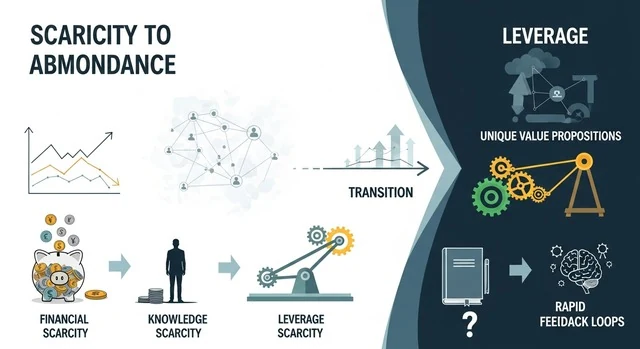
Scarcity Type Conversion and Wealth Creation Framework
This framework outlines strategic approaches for turning financial, temporal, and human resource limitations into advantages.
How can we convert our own real-world scarcities into building blocks for success? The following matrix details a strategic framework for transforming limitations in financial, temporal, and human resources into opportunities.
| Type of Scarcity | Common Pitfall | Tycoon’s Mindset Shift | Action Plan | Target Metrics |
|---|---|---|---|---|
| Financial Scarcity | – Excessive caution – Chasing short-term, high-risk returns |
“Without capital, I will focus on the efficiency and essence of my idea.” | – Develop a zero-capital, knowledge-based business process. – Leverage third-party platforms and open-source tools. |
– Achieve zero fixed costs. – Maintain gross profit margins above 80%. |
| Temporal Scarcity | – Chronic fatigue – Blurred priorities and burnout |
“With limited time, I will focus exclusively on the most impactful activities.” | – Apply the 80/20 rule (Pareto Principle). – Automate repetitive tasks using AI and tools. |
– Double focus on core tasks. – Reduce unnecessary meetings and tasks by 50%. |
| Network Scarcity | – Feelings of isolation – Disadvantage due to information gaps |
“Lack of established networks allows for rule-breaking innovation.” | – Direct outreach via cold emails and social media. – Proactively offer value to key individuals. |
– Forge exclusive partnerships with decision-makers. |
YMYL Guidelines: Mitigating the Risks of a Scarcity Mindset
Prolonged scarcity can lead to detrimental cognitive effects, necessitating careful risk management.
According to psychiatric reports from *Harvard Health Publishing*, chronic scarcity can elevate cortisol levels, resulting in “tunnel vision”—a critical side effect that impairs long-term risk assessment by fixating solely on immediate survival.
Therefore, while using scarcity as a motivator, it is crucial to establish robust safety nets to protect your financial and health capital.
- Recharge Your Cognitive Bandwidth: Dedicate one day weekly to complete disconnection from business matters for “strategic rest.” Macro-level strategies become clear only when the mind is relaxed.
- Secure Your Financial Runway: When investing or launching a venture, maintain a financial buffer covering at least six months of essential living expenses. This prevents falling into the tunnel vision trap.
- Protect Your Physical Capital: Accumulated wealth is meaningless without health. Adequate sleep and consistent nutrition are fundamental physical resources for overcoming scarcity.
Conclusion: Transform Your Scarcity into a Success Story
Scarcity is not a punishment; it’s the prelude to a compelling success narrative.
“The fact that you lack resources is simply a prerequisite that will make the story of your future success even more dramatic and valuable.”
Scarcity is not a predetermined fate. Instead, it’s an optimal strategic environment that awakens your inner drive and allows you to identify market opportunities with precision. Do not blame yourself or halt your progress due to a lack of capital. Most legendary tycoons started from precisely this point of ‘scarcity.’
What truly matters is not “what is missing,” but “what fundamental aspect will you focus on through this lack.” Arm yourself with scarcity as a weapon and engage with the market.

🚀 Start Your Wealth Creation Journey
What is the biggest scarcity factor currently impacting your cognitive bandwidth? Choose one: money, time, or network. Then, tonight, list three aggressive, zero-cost actions you can take specifically because of that scarcity.
Your tycoon mindset begins with this commitment and execution. Subscribe to [Vital Guide Newsletter] to receive weekly email insights on the concrete financial portfolio strategies of individuals who transformed scarcity into assets.
Sources and Updates
Sources:
- Harvard University Behavioral Economics Research
- Princeton University Psychology Department Studies
- Bloomberg Wealth Management Insights
- Harvard Health Publishing – Psychiatry Reports
Last Updated: 2024-07-27
Expert Quick Take
This framework is highly recommended for ambitious individuals facing resource constraints, particularly entrepreneurs and freelancers aiming to maximize impact with minimal capital. Those prone to chronic stress should prioritize the risk mitigation strategies to prevent burnout.