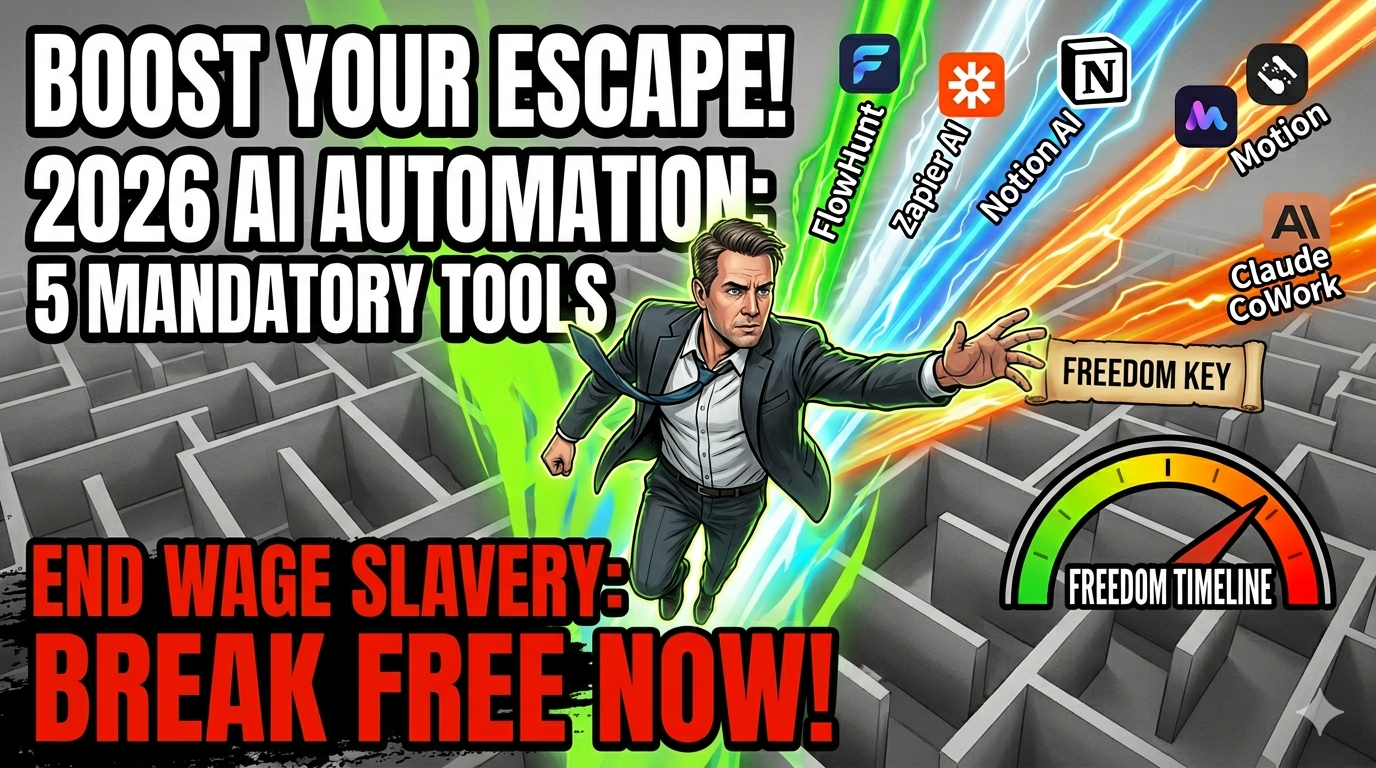
9-to-5 Escape Velocity: 5 Mandatory AI Workflow Automation Tools to Fast-Track Your Independence in 2026
[Executive Summary] This guide provides a strategic analysis of 5 cutting-edge AI workflow automation tools (FlowHunt, Zapier AI, Notion AI, Motion, and Claude CoWork) engineered to eliminate high-volume, low-value task repetition for modern knowledge workers. By integrating these systems, corporate professionals can reduce manual operational overhead by up to 40%, significantly accelerating their timeline toward financial independence and career autonomy.
The traditional corporate contract is fundamentally broken, and the timeline for architectural career independence has officially shifted. According to a comprehensive 2026 labor market analysis by the Boston Consulting Group (BCG), over 50% of professional roles are currently undergoing radical structural augmentation driven by artificial intelligence. We are no longer operating in an era where hard work alone guarantees upward mobility; instead, strategic leverage dictates financial survival.
For corporate professionals aiming to exit the 9-to-5 matrix, the primary bottleneck isn’t a lack of vision—it is a severe deficit of unencumbered time. Knowledge workers lose an estimated 3.6 hours daily to “work about work,” which includes manual data syncing, context-switching across disjointed SaaS platforms, and repetitive operational communication. By deployed agentic AI workflows, you can effectively buy back this lost capital, allowing you to construct high-yield consulting structures, digital assets, or independent ventures while maintaining your primary income.
Key Takeaways
- The Automation ROI: Deploying advanced multi-agent AI workflows can recapture up to 15–20 hours per week of high-cognitive availability.
- Agentic Shift in 2026: Automation has evolved from simple “If-This-Then-That” triggers to complex, context-aware AI agents capable of autonomous decision-making and cross-platform execution.
- YMYL Strategic Warning: True financial liberation requires utilizing automated systems to build real-world cash flow, not relying on speculative shortcuts.
The 2026 Automation Stack: Top 5 AI Tools for Workflow Sovereignty
To engineering a clean corporate exit, your operational infrastructure must be lean, highly integrated, and largely autonomous. The following five platforms represent the absolute gold standard in enterprise-grade productivity and intelligent workflow orchestration for 2026.
1. FlowHunt: The Ultimate Multi-Agent Orchestrator
┌────────────────────────────────────────────────────────┐
│                      FLOWHUNT                          │
├────────────────────────────────────────────────────────┤
│  [Fireflies Transcript] ──> [AI Context Engine]       │
│                                    │                   │
│         ┌──────────────────────────┴────────────────┐  │
│         ▼                                           ▼  │
│  [Notion Workspaces]                         [Slack Routing]   │
└────────────────────────────────────────────────────────┘
The greatest friction points in modern business operations are the manual hand-offs between separate software applications. FlowHunt has emerged as the definitive layer sitting above your entire tech stack, designed specifically to connect disparate systems via an intuitive visual canvas.
Unlike legacy tools that require linear, rigid rules, FlowHunt employs autonomous AI agents that evaluate context. For example, a standard independent consultant can establish a FlowHunt sequence that pulls a raw meeting transcript from an internal server, extracts strategic action items, automatically populates localized project management boards, drafts a hyper-personalized follow-up email based on historical client data, and routes urgent notifications to team channels. By eliminating the manual copy-paste pipeline, it directly solves the issue of operational fragmentation.
2. Zapier AI: Natural Language Ecosystem Engineering
For over a decade, API integration required either deep technical knowledge or meticulous mapping of webhooks. Zapier AI has completely demystified this process by introducing natural language automation building.
Instead of configuring complex data variables across thousands of potential integrations, users describe their desired outcome in plain English (e.g., “Whenever a high-tier lead submits a form on my landing page, cross-reference their company via external data enrichment, draft a custom proposal outline, and update my CRM pipeline”). Zapier’s modern architecture natively integrates with frontier large language models, allowing the system to handle unstructured data tables, interpret human intent, and dynamically alter workflow pathways based on the contents of an incoming email or document.
3. Notion AI: Centralized Workspace Intelligence
Document fragmentation is a silent productivity killer. When your corporate exit strategy relies on massive research, content engines, or product documentation, searching through hundreds of separate files wastes immense mental bandwidth. Notion AI resolves this by turning your centralized internal workspace into an interactive, globally searchable database.
The 2026 iteration of Notion AI features deep workspace synthesis. It doesn’t simply write copy or summarize text blocks; it acts as an internal chief of staff. You can query your entire knowledge base globally (e.g., “Analyze all market research notes from the past quarter and identify the top three underserved customer pain points”), and it will synthesize a structured report complete with inline citations linking back to your original source files.
4. Motion: Algorithmic Calendar and Task Optimization
Time management is fundamentally a resource allocation problem. Human beings are notoriously susceptible to the planning fallacy—underestimating how long a task will take and failing to properly prioritize high-impact work over reactive notifications. Motion leverages predictive analytics to completely automate your schedule.
                  MOTION CALENDAR ENGINE

    [Inputted Tasks] ───┐
    [Fixed Meetings] ───┼─> [Predictive AI] ─> [Dynamic Timeline]
    [Hard Deadlines] ───────────┘             (Real-time Adjustments)
Instead of using a passive, static calendar, you feed Motion your raw tasks, approximate durations, and hard deadlines. The platform’s algorithmic engine then builds a dynamic timeline for your day. If an urgent client meeting disrupts your afternoon, Motion automatically shifts your remaining tasks into optimized blocks, ensuring deadlines are hit without requiring manual rearranging. According to operational efficiency studies tracking modern knowledge workers, this fluid prioritization saves users an average of one full work week per month.
5. Claude CoWork: Collaborative High-Cognition Execution
Executing a business strategy requires heavy-lifting cognitive work: drafting legal disclosures, reviewing complex financial agreements, or programming application backends. Claude CoWork steps into this void as an enterprise-grade collaborative agent that works seamlessly alongside you.
Powered by advanced context windows, Claude CoWork excels at handling highly nuanced, domain-specific assignments. It goes far beyond standard generative text fields by maintaining deep memory across expansive projects. Whether you need to audit an intricate affiliate contract or write cleanly structured code for a proprietary software tool, this platform reduces the initial execution phase from days to mere minutes, allowing solo operators to match the output of entire corporate departments.
Strategic Comparison of AI Automation Platforms
To assist you in allocating your technology budget efficiently, the table below provides a comprehensive breakdown of each platform’s core operational strength, primary target workflow, and average time-savings potential.
| Automation Platform | Primary Operational Core | Target Exit Workflow | Typical Time Reclaimed | Implementation Complexity |
| FlowHunt | Multi-Agent Visual Canvas | Cross-Platform Pipeline Syncing | 12–15 Hours / Week | Moderate (Requires Architecture) |
| Zapier AI | Natural Language Integrations | Automated Lead Intake & CRM Tracking | 8–10 Hours / Week | Low (Conversational Build) |
| Notion AI | Workspace Synthesis & Q&A | Market Research & Content Repositories | 5–7 Hours / Week | Very Low (Native Integration) |
| Motion | Algorithmic Resource Allocation | Calendar Optimization & Defending Deep Work | 6–8 Hours / Week | Low (Automated Setup) |
| Claude CoWork | High-Cognitive Contextual Execution | Technical Development & Advanced Copywriting | 10–14 Hours / Week | Low to Moderate (Context Dependent) |
The YMYL Framework for Professional Transition
Transitioning out of corporate employment involves real financial, legal, and operational risk. Data published by Bloomberg Financial consistently emphasizes that the primary point of failure for new enterprises is poor operational cash flow management and premature scaling. When deploying AI automation to build your bridge to independence, it is critical to adhere to strict professional guidelines.
Critical Operational Warning: AI tools are phenomenal engines for amplification and leverage, but they lack human contextual judgment. Never allow an automated system to push financial transactions, publish final legal contracts, or distribute client-facing deliverables without a rigorous human-in-the-loop validation process.
Treat your automation stack exactly like an internship pool: delegate high-volume tasks, but carefully audit every single output to guarantee compliance, accuracy, and brand safety.
Action Plan: Building Your Automation Bridge
Do not attempt to overhaul your entire workflow overnight. Instead, adopt a methodical, staged approach to engineering your operational sovereignty:
- Audit Your Friction Points: For the next 48 hours, document every single repetitive task you perform that takes more than 10 minutes (e.g., updating spreadsheets, copying data, drafting standard emails).
- Deploy a Single Gateway Tool: Start by integrating FlowHunt or Zapier AI to automate your single most annoying multi-app data pipeline.
- Protect Your Focus Blocks: Use Motion to lock down at least 90 minutes of daily, uninterrupted deep work dedicated exclusively to your independent project.
- Scale via Copilots: Utilize Claude CoWork to handle the heavy lifting of content drafting, research synthesis, or technical builds to hit the market faster.
The technological infrastructure required to bypass decades of corporate climbing is fully accessible right now. The only remaining variable is your execution.
Are you ready to stop trading hours for a linear salary? Download our comprehensive, step-by-step structural blueprint to automating your business operations and building an unshakeable exit strategy.