The Cognitive Cost of Clutter: Why Minimalism Is the Ultimate Neurological Hack for Focus and Energy
Have you ever felt an inexplicable sense of anxiety just by looking at a messy room? It is not just in your head—it is a measurable neurological response to environmental overload. Science now proves that physical clutter directly competes for your brain’s limited processing capacity, hijacking your focus and draining your daily energy reserves. By adopting a minimalist interior, you aren’t just styling a space; you are actively optimizing your brain chemistry for peak cognitive performance.
Key Takeaways
- The Cortisol Connection: High-clutter environments directly trigger the release of cortisol (the stress hormone), leading to chronic mental fatigue.
- Visual Field Capacity: The brain’s visual cortex is easily overwhelmed by excess stimuli, drastically reducing working memory and task efficiency.
- Biophilic & Spatial Energy: Minimalist design leverages natural light and open space to improve circadian rhythms and boost daily vitality.
The Neurological Cost of Clutter: What Happens to Your Brain in a Messy Room
To understand why minimalism transforms your personal energy, we must first look at how the human brain processes its environment. Every object in your line of sight is a piece of data that your brain must log, track, and interpret.
A landmark study conducted by the Princeton Neuroscience Institute used functional magnetic resonance imaging (fMRI) to map how the human brain responds to organized versus disorganized environments. The researchers discovered that multiple stimuli present in the visual field at the same time compete for neural representation. In plain English: clutter restricts your ability to focus and limits your brain’s capacity to process information.
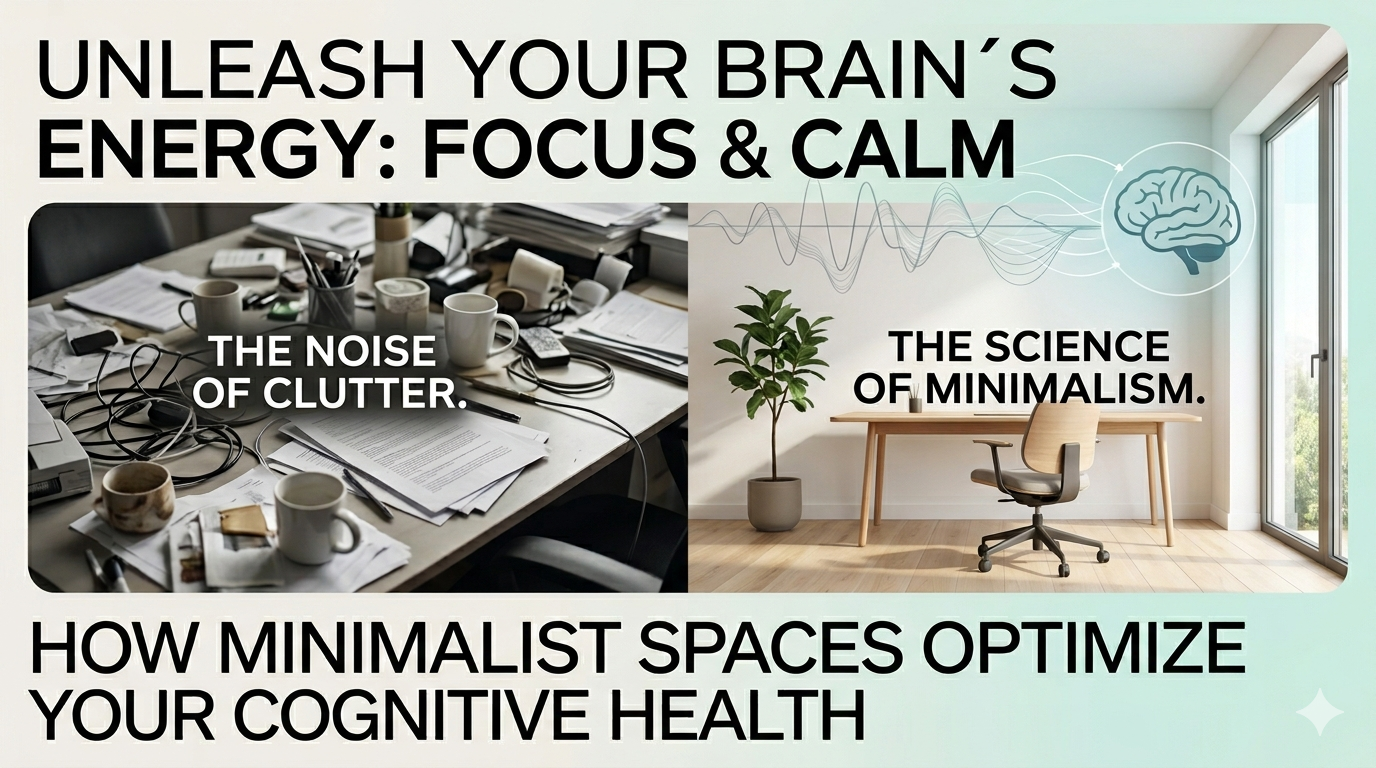
When your desk is piled high with papers, sticky notes, half-empty coffee mugs, and tangled cords, your visual cortex is forced to expend tremendous energy just filtering out the background noise. This constant filtering leads to a phenomenon known as cognitive fatigue. You find yourself staring at your computer screen, unable to start a task, completely unaware that the physical mess around you is draining your mental battery.
[Excess Visual Stimuli] ---> [Neural Competition in Visual Cortex] ---> [Cognitive Fatigue]
The Endocrinological Impact: Cortisol and Environmental Stress
The impact of your environment goes far beyond simple distraction; it alters your hormone levels. A widely cited study published in the Journal of Personality and Social Psychology by researchers at UCLA monitored the daily lives of 30 dual-income families. They found a direct correlation between high object density in the home and elevated levels of cortisol (the primary stress hormone) in women.
Chronic elevation of cortisol is incredibly damaging to both mental and physical health. It disrupts sleep patterns, impairs memory, and creates a state of low-grade, perpetual anxiety.
- The Minimalist Antidote: When you deliberately reduce the number of possessions in a room, you remove these subconscious stress triggers. A minimalist space acts as a visual reset button, allowing your nervous system to shift from a sympathetic state (fight-or-flight) to a parasympathetic state (rest-and-digest). This shift is what people commonly describe as a change in the “energy” or “vibe” of a room.
Spatial Psychology: How Open Space Amplifies Focus and Working Memory
In the realm of cognitive psychology, working memory is the mental workbench we use to hold and manipulate information over short periods. It is highly volatile and easily disrupted.
According to research insights often highlighted by institutions like Harvard Health Publishing, our physical surroundings play a massive role in environmental psychology. A cramped, over-furnished room creates a psychological sense of confinement, which triggers a subtle, claustrophobic stress response.
Conversely, open space promotes a psychological concept known as cognitive expansion. When your eyes can move freely across a room without stumbling over obstacles, your brain experiences a sense of freedom and safety. This spatial liberation allows your working memory to allocate 100% of its resources to the complex task at hand, whether you are analyzing financial markets or writing a medical research paper.
Lighting, Color Psychology, and Circadian Vitality
Minimalist interior design is rarely just about having fewer chairs; it is fundamentally about maximizing the raw, elemental features of a space: light and structure.
| Design Element | Neurological Mechanism | Cognitive & Health Outcome |
| Maximized Natural Light | Suppresses daytime melatonin; triggers serotonin production. | Enhanced alertness, synchronized circadian rhythm, better sleep. |
| Monochromatic/Neutral Palette | Minimizes ocular strain; reduces amygdala activation. | Lower baseline anxiety, calm focus, higher emotional stability. |
| Negative Space (Empty Corners) | Gives the optical nerve a place to rest; stops visual scanning. | Reduced cognitive fatigue, increased creative problem-solving. |
| Clean Line Geometry | Matches the brain’s preference for predictable, structured patterns. | Faster spatial processing, lower subconscious mental friction. |
The Power of Natural Light
Minimalism heavily emphasizes bare or lightly dressed windows. Bloomberg Businessweek has frequently covered architectural trends showing that corporate offices utilizing minimalist, daylight-centric designs see massive jumps in employee productivity and fewer sick days. Exposure to natural light early in the day boosts the production of serotonin (the mood-stabilizing hormone) and ensures that your body releases melatonin at the right time tonight, ensuring deep, restorative sleep.
The Financial and Mental ROI of Environmental Asset Management
Think of your home or office as a premium piece of real estate within your own mind. Every object you buy and place in your environment requires a “maintenance fee” paid in human attention. You have to clean it, organize it, look at it, and worry about it.
By applying a strict minimalist framework—inspired by the rigorous asset management principles you see in global financial sectors—you are essentially liquidating low-value physical assets to fund your highest-value cognitive assets: your time, your focus, and your peace of mind.
When you walk into a room containing only a high-quality desk, an ergonomic chair, a single piece of inspiring art, and a thriving green plant, there is no mental friction. The energy of the room changes because the drain on your personal energy has been entirely eliminated.
Practical Blueprint: Transforming Your Space for Peak Cognitive Flow
Transitioning to a focus-optimized, minimalist space doesn’t mean living in a sterile white box. It means curation with scientific intent.
- The 80/20 Visual Rule: Ensure that at least 80% of your visible surfaces (floors, countertops, desks) are completely clear. Keep only the top 20% of essential tools or meaningful objects in plain sight.
- Implement Smart Hiding: Use closed storage solutions. If you must have files, electronics, and cables, keep them behind solid cabinet doors. Out of sight truly is out of mind when it comes to the visual cortex.
- Incorporate Biophilic Elements: A single, well-placed plant (like a Snake Plant or Peace Lily) introduces natural geometry to a minimalist room. Research shows biophilic design lowers blood pressure and sharpens attention span.
Conclusion: Reclaim Your Energy from the Mess
The state of your home and workspace is a direct reflection—and a direct driver—of the state of your mind. Clutter is not benign; it is a silent thief of your focus, a constant generator of cortisol, and a barrier to your highest cognitive potential. By embracing minimalism, you are leveraging environmental psychology to build a sanctuary of high performance and deep peace.
Are you ready to unlock your brain’s true potential? Take 15 minutes today to completely clear your immediate workspace. Strip away the non-essentials, maximize your natural light, and experience the immediate, scientifically proven surge in your mental clarity and energy.
For more science-backed guides on optimizing your health, productivity, and lifestyle environment, subscribe to our weekly newsletter.