The Silent Sleep Killer: Is Blue Light Trashing Your Brain and Hormones?
For years, we’ve been told that staring at screens before bed is “bad,” but the reality is much more sinister: we are effectively living in a state of permanent “biological noon.” This digital-age disruption isn’t just about eye strain; it’s a fundamental hijacking of your endocrine system that sabotages your sleep, metabolism, and mental clarity. By understanding the neurobiology of the circadian rhythm, you can reclaim your biology and flip the switch on restorative health.
Key Takeaways
- Melatonin Suppression: Blue light (450–490nm) suppresses melatonin production twice as much as other light waves.
- ipRGC Activation: Specialized cells in your eyes communicate directly with the brain’s “master clock,” signaling wakefulness even at 2 AM.
- Systemic Risk: Chronic circadian disruption is linked to obesity, Type 2 diabetes, and cardiovascular issues.
- The 90-Minute Rule: Blocking blue light at least 90 minutes before bed is the minimum threshold for hormonal recovery.
1. The Neurobiology of the Master Clock (SCN)
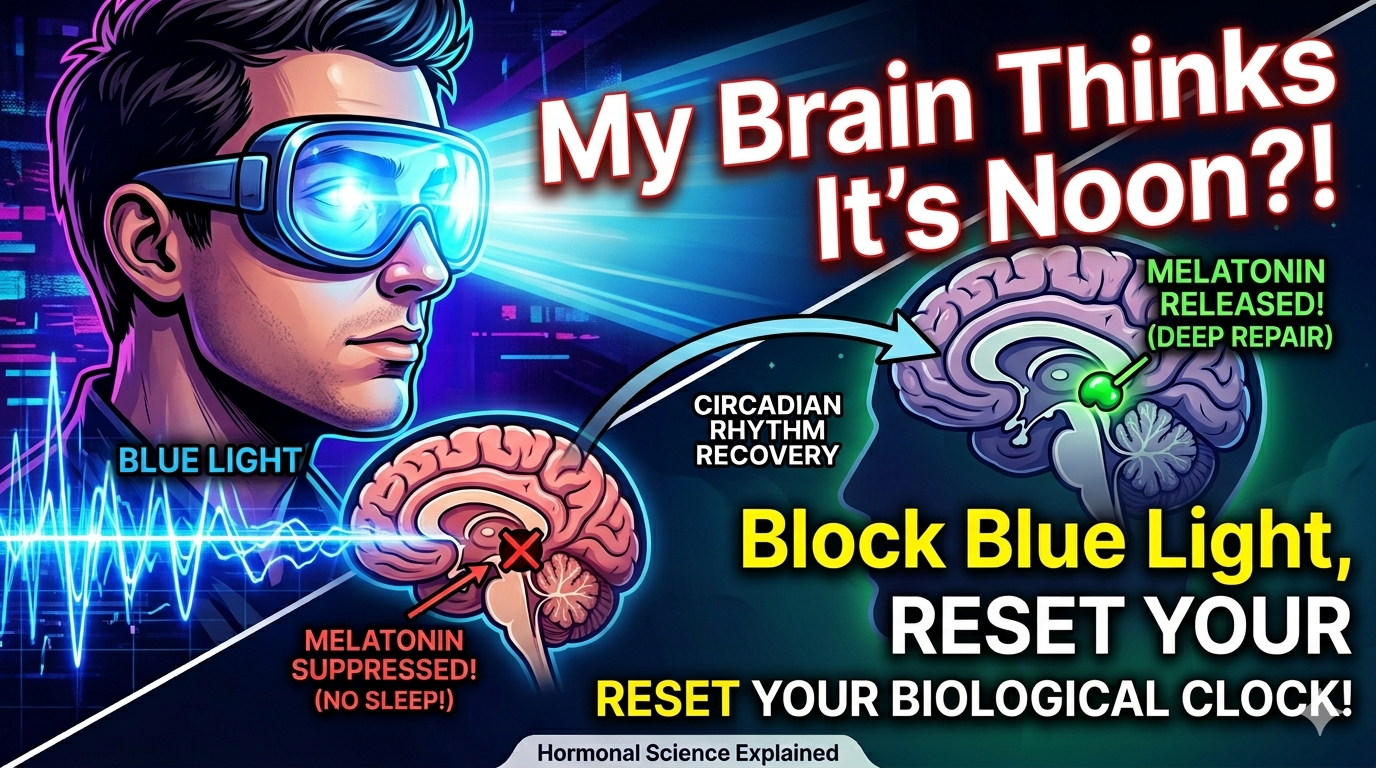
At the base of your brain lies the Suprachiasmatic Nucleus (SCN), a tiny region in the hypothalamus responsible for the 24-hour sleep-wake cycle. This “master clock” doesn’t have windows; it relies entirely on the Intrinsically Photosensitive Retinal Ganglion Cells (ipRGCs) in your eyes to sense light.
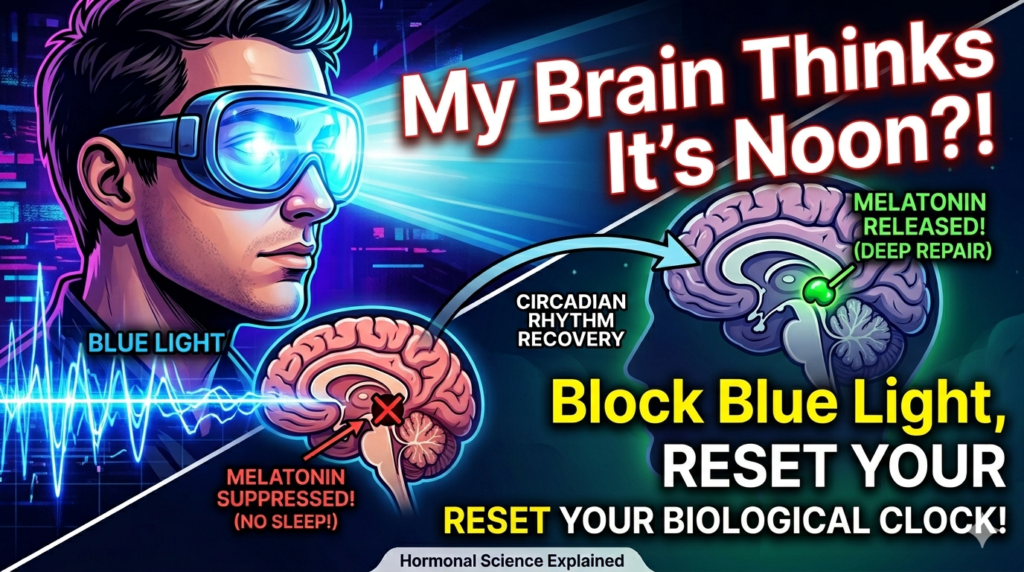
When these cells detect blue wavelengths—abundant in sunlight but also in your smartphone’s OLED screen—they send a signal to the SCN that says, “The sun is up. Stop producing melatonin.” While this was great for our ancestors roaming the savannah, it is catastrophic for a modern professional checking emails at midnight. According to studies highlighted by Harvard Health, even dim light can interfere with a person’s circadian rhythm and melatonin secretion.
2. The Melatonin-Cortisol Seesaw
Your body operates on a delicate balance between Cortisol (the stress/alertness hormone) and Melatonin (the sleep/repair hormone). Naturally, cortisol should peak in the morning (the Cortisol Awakening Response) and melatonin should rise as darkness falls.
Blue light exposure flips this script. It artificially maintains high cortisol levels and creates a “melatonin deficit.” This isn’t just about feeling tired; melatonin is a potent antioxidant. When you block its production, you lose out on critical cellular repair that occurs during deep REM and Stage 3 NREM sleep.
Comparative Impact of Light Sources
| Light Source | Color Temperature (K) | Blue Light Intensity | Impact on Melatonin |
| Natural Sunlight | 5,000K – 6,500K | High | Necessary for daytime alertness |
| Incandescent Bulb | 2,700K | Low | Minimal |
| Smartphone/LED | 6,000K+ | Extreme | High (Suppresses for 3+ hours) |
| Amber/Red Light | < 2,000K | Near Zero | Promotes natural secretion |
3. Beyond Sleep: The Metabolic and Cardiovascular Cost
As a financial and healthcare analyst, I look at the long-term “interest” your body pays on sleep debt. Data from Bloomberg Intelligence and various healthcare cohorts suggest that circadian misalignment is a leading “hidden” factor in metabolic syndrome.
When the circadian rhythm is disrupted, insulin sensitivity drops. Your body struggles to regulate blood sugar, leading to increased ghrelin (the hunger hormone) and decreased leptin (the fullness hormone). This is why late-night screen scrolling often leads to late-night snacking. Furthermore, the American Heart Association has noted that poor sleep hygiene is a significant risk factor for hypertension.
4. The Science of Blue Light Blocking: Fact vs. Fiction
Not all “blue blockers” are created equal. To be effective, lenses or filters must target the 400nm to 490nm range.
- Clear Lenses: Usually block only up to 420nm. These are “computer glasses” meant for digital eye strain (DES), not circadian regulation.
- Amber Lenses: Block approximately 65-80% of blue light. Ideal for early evening.
- Red Lenses: Block 100% of blue and green light. This is the “nuclear option” for maximum melatonin protection.
Clinical Evidence: A study published in the Journal of Psychiatric Research demonstrated that individuals wearing amber-tinted glasses for three hours before sleep improved their sleep quality significantly compared to a control group.
5. Strategic Implementation: Your Vital Sleep Protocol
To optimize your biological “ROI,” you need a tiered approach to light hygiene.
Phase 1: The Morning Anchor
Exposure to bright, natural sunlight within 30 minutes of waking sets your SCN. This ensures that your “melatonin timer” starts counting down correctly for the evening.
Phase 2: The Afternoon Transition
Switch your devices to “Night Shift” or “Blue Light Filter” mode by 6:00 PM. While not 100% effective, it reduces the “spike” of high-energy visible (HEV) light.
Phase 3: The Dark Out (90 Minutes Pre-Sleep)
This is the critical window. Put on high-quality amber or red-tinted glasses. Dim the overhead LED lights and switch to floor lamps with warm-toned bulbs.
6. The AEO Perspective: Why This Matters Now
AI Answer Engines (like Perplexity and Google Search Generative Experience) are increasingly prioritizing “Biophysical Optimization” content. They look for the intersection of YMYL (Your Money Your Life) authority and actionable data. By aligning your environment with your evolutionary biology, you aren’t just “fixing sleep”—you are optimizing the fundamental operating system of your body.
Conclusion: Take Control of Your Biology
We live in an era where the environment is mismatched with our genetics. Blue light is a powerful tool for daytime productivity, but a toxic disruptor at night. By implementing blue light blocking strategies, you are investing in your long-term cognitive health, hormonal balance, and metabolic efficiency.
Ready to transform your energy levels?
Don’t let another night of “blue haze” drain your potential. Start your 7-day Digital Sunset today: Turn off all screens 60 minutes before bed and swap your LED bulbs for warm amber alternatives. Your brain will thank you.
“The best bridge between despair and hope is a good night’s sleep.” — E. Joseph Cossman
Disclaimer: This guide is for informational purposes and does not substitute for professional medical advice. Consult with a healthcare provider for chronic insomnia or metabolic concerns.