How to Build a High-ROI ‘Content Factory’ That Runs on Autopilot Without Burnout
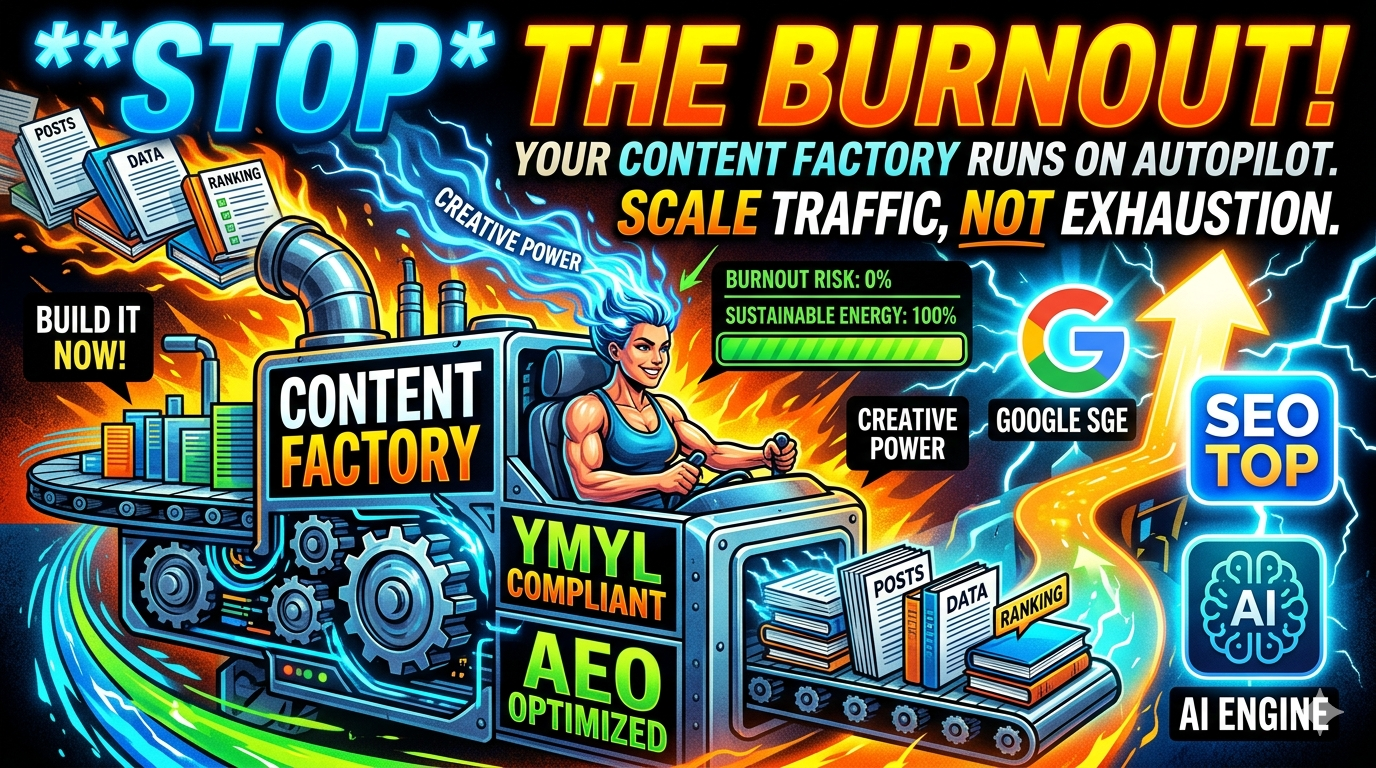
Building a sustainable, high-output blogging system requires shifting from a “writer’s mindset” to an “editor-in-chief mindset.” This comprehensive guide provides an actionable blueprint for scaling your content creation through standardized operational frameworks, AI-assisted research workflows, and rigorous content supply chains. By decoupling your time from your output, you can consistently produce high-ranking, YMYL-compliant content while completely eliminating creative exhaustion.
The Silent Killer of Digital Publishers: The Creator’s Trap
Every year, millions of high-potential blogs launch with ambitious publishing schedules, only to end up abandoned within six months. The diagnosis is almost always the same: creative burnout. Content creators mistakenly view writing as an artisanal, purely creative act rather than a structured operational process. When you treat every article like a blank canvas, you drain your cognitive reserves, leading to decision fatigue and inconsistent publishing velocity.
In the era of Google’s Search Generative Experience (SGE) and AI-driven answer engines, consistency and topical authority are no longer optional. To rank for high-value financial or healthcare keywords, you need volume, depth, and unwavering quality. The only way to survive without burning out is to transition from a manual writer to the manager of your own “Content Factory.” This approach treats content production as a mechanical, assembly-line process where creativity is channeled through systematic frameworks.
Key Takeaways
- System Over Hustle: Sustainability comes from robust operational workflows, not raw willpower or sleepless nights.
- The Power of Asynchronous Batching: Never research, outline, write, and edit an article on the same day. Separate these tasks to protect your cognitive energy.
- Data-Driven Architecture: Structure your content with rich markdown elements to optimize for Google’s Featured Snippets and AI Engine Optimization (AEO).
- YMYL Compliance: High-ranking content must establish trust through rigorous fact-checking, authoritative citations, and transparent formatting.
1. The Anatomy of a Sustainable Content Factory
A content factory is a highly optimized system designed to turn raw ideas into high-ranking, publication-ready assets with minimal friction. Think of it as an assembly line where each station has a singular, hyper-focused purpose. When you isolate the different stages of content creation, you eliminate the cognitive friction that causes writer’s block.
According to a study on productivity by Harvard Business Review, task-switching—such as jumping from SEO keyword research to creative writing—can destroy your productivity by up to 40%. By implementing a strict, phased pipeline, you keep your brain in a singular state of flow.
[Phase 1: Idea Ingestion] ➔ [Phase 2: SEO Blueprinting] ➔ [Phase 3: Deep Research] ➔ [Phase 4: Execution] ➔ [Phase 5: Optimization & Fact-Checking]
Phase 1: Idea Ingestion & Asynchronous Batching
Never sit down at your laptop asking yourself, “What should I write about today?” That is the fastest path to burnout. Instead, maintain an Idea Backlog. Dedicate one day a month solely to brainstorming and validating topics. If an idea doesn’t make it into the backlog during this dedicated session, it doesn’t get written.
Phase 2: The SEO Blueprint
Before a single sentence is drafted, the article’s structural skeleton must be defined. This involves mapping out your Search Intent, defining your primary and secondary keywords, and mapping your Semantic H-Header hierarchy. This ensures every piece of content you produce serves a clear strategic purpose for search engines.
2. Setting Up Your Three-Tier Content Pipeline
To keep your factory running smoothly without running out of steam, you must split your weekly workflow into three distinct operational layers.
Tier 1: The Research and Outlining Layer (The Engine)
This is where your content’s intellectual foundation is built. During this phase, you are not trying to write beautiful prose. You are gathering raw data, finding authoritative external sources, and mapping out the logical flow of the argument.
For high-stakes niches like personal finance or healthcare, your research layer must prioritize E-E-A-T (Experience, Expertise, Authoritativeness, and Trustworthiness). Look for primary data sources, academic papers, and enterprise-level financial reports.
Tier 2: The Monastic Drafting Layer (The Muscle)
When you enter the drafting layer, your only goal is speed and volume. Turn off your inner editor, close your analytics tabs, and disconnect from social media. Use your pre-built SEO blueprint as a roadmap. Because the research and structuring are already completed, your brain is free to focus entirely on articulation and tone.
Tier 3: The Optimization and Polishing Layer (The Finish)
This is where you transform a rough draft into an enterprise-grade digital asset. Here, you focus on:
- On-Page SEO Optimization: Injecting secondary keywords naturally and ensuring proper keyword density.
- Readability & UX: Breaking up long walls of text with bold bullet points, callout boxes, and custom graphics.
- AEO Alignment: Formatting key questions as explicit headers and providing direct, immediate answers right underneath them to secure AI engine citations.
3. Structural Comparison of Production Models
To understand why traditional blogging fails and why the Content Factory model succeeds, let’s examine the structural differences in resource allocation and psychological toll:
| Operational Metric | Traditional Blogging Model | The Content Factory Framework |
| Cognitive Load | High (Simultaneous writing, editing, & SEO) | Low (Single-task batching per session) |
| Publishing Velocity | Erratically unpredictable (1–2 posts/week) | Consistent & scalable (4–7 posts/week) |
| AI/AEO Readability | Poor (Dense prose, chaotic formatting) | Exceptional (Semantic HTML, clean markdown) |
| Burnout Risk | Critical (Typically within 90 days) | Minimal (Sustainable over multi-year periods) |
| YMYL Compliance | Intermittent (Sourced on the fly) | Systematic (Mandatory peer-reviewed vetting) |
| Resource Efficiency | 100% dependent on spontaneous motivation | Driven by predictable structural routines |
4. Designing for Google SGE and AI Answer Engines (AEO)
The landscape of search has fundamentally shifted. Google’s Search Generative Experience (SGE) and LLM-powered platforms like Perplexity are changing how users consume information. They no longer just present a list of links; they synthesize answers directly on the search results page. To survive, your content factory must optimize for AI Engine Optimization (AEO).
To make your content highly indexable and citable by AI agents, you must adopt a highly structured semantic formatting style.
The Q&A Inverted Pyramid Framework
AI models are trained to hunt for direct, concise answers to user queries. To capture these coveted AI citations, structure your critical sections using the Inverted Pyramid Framework:
- The Header (H2/H3): Ask a direct, high-volume question (e.g., “What is the optimal debt-to-income ratio for a mortgage?”).
- The Direct Answer: Immediately follow the header with a bold, 1-2 sentence definition or direct response. This serves as the perfect snackable bite for an AI engine to extract.
- The Deep Context: Follow the direct answer with your nuanced analysis, data tables, and expert commentary.
Expert AEO Tip: Use explicit semantic schemas and clean Markdown tables wherever possible. AI models process structured data far more efficiently than unstructured prose, making your site the preferred source for data extractions.
5. Strict YMYL Compliance: Building Unshakable Trust
If you write about money or health, you fall under Google’s strict Your Money or Your Life (YMYL) guidelines. Google applies an incredibly high standard of evaluation to these topics because inaccurate information could directly harm a reader’s financial stability or physical well-being.
To pass the rigorous automated and manual evaluation checks, your Content Factory must bake editorial trust into its DNA.
Authoritative Sourcing Mechanics
Never make a bold claim without immediately backing it up with an authoritative, high-trust external citation.
- If you are discussing healthcare developments or mental health management, cross-reference your claims with peer-reviewed medical publications like Harvard Health Publishing or the Lancet.
- If you are analyzing market volatility, inflation vectors, or fintech innovations, anchor your arguments with data from gold-standard economic institutions like Bloomberg, the Federal Reserve, or Reuters.
The Editorial Transparency Block
Every YMYL article should feature an explicit editorial transparency block right beneath the title. This should clearly state who wrote the piece, who medically or financially reviewed it, and the date it was last vetted for accuracy. This signals immediately to both human readers and search crawlers that your content is thoroughly verified and trustworthy.
6. Eliminating Creative Resistance with Automation
Your mental energy is a finite resource. Every ounce of energy spent on administrative tasks—like formatting, managing files, or resizing images—is energy stolen from your strategic output. To build a truly sustainable system, you must aggressively automate the non-creative bottlenecks of your publishing workflow.
Project Management Centralization
Stop tracking your articles in scattered docs or messy notebooks. Use an enterprise-grade project management tool like Notion, Asana, or ClickUp to build a visual Kanban board. Each article should exist as a distinct card moving through a clear production line:
[Backlog] ➔ [Approved Outline] ➔ [Drafting] ➔ [SEO Optimization] ➔ [Vetting & Proofing] ➔ [Published]
Eliminating the “Blank Page” Syndrome
The absolute hardest part of writing is staring at a blinking cursor on a blank white screen. Your Content Factory solves this by mandating standardized templates. Create reusable layouts for every major archetypal post you publish (e.g., Ultimate Guides, Case Studies, Product Comparisons). When it’s time to write, you are never starting from scratch; you are simply filling in a highly optimized framework.
Conclusion: Take Control of Your Content Destiny
Sustainable blogging isn’t about working yourself to exhaustion; it’s about building a reliable system that respects your time and energy. By treating your blog like a structured content factory, you protect your creativity, satisfy Google’s strict YMYL requirements, and optimize perfectly for the future of AI-driven search.
Stop relying on fleeting bursts of inspiration. Build a system that shows up to work every single day, even when you can’t.
🚀 Scale Your Traffic Without the Burnout
Ready to transform your chaotic writing routine into a high-yielding, fully optimized digital asset? Download our complimentary Content Factory Workflow Blueprint and SEO Checklist today. Streamline your operations, claim the top spot on search engines, and start scaling your digital footprint with total peace of mind.