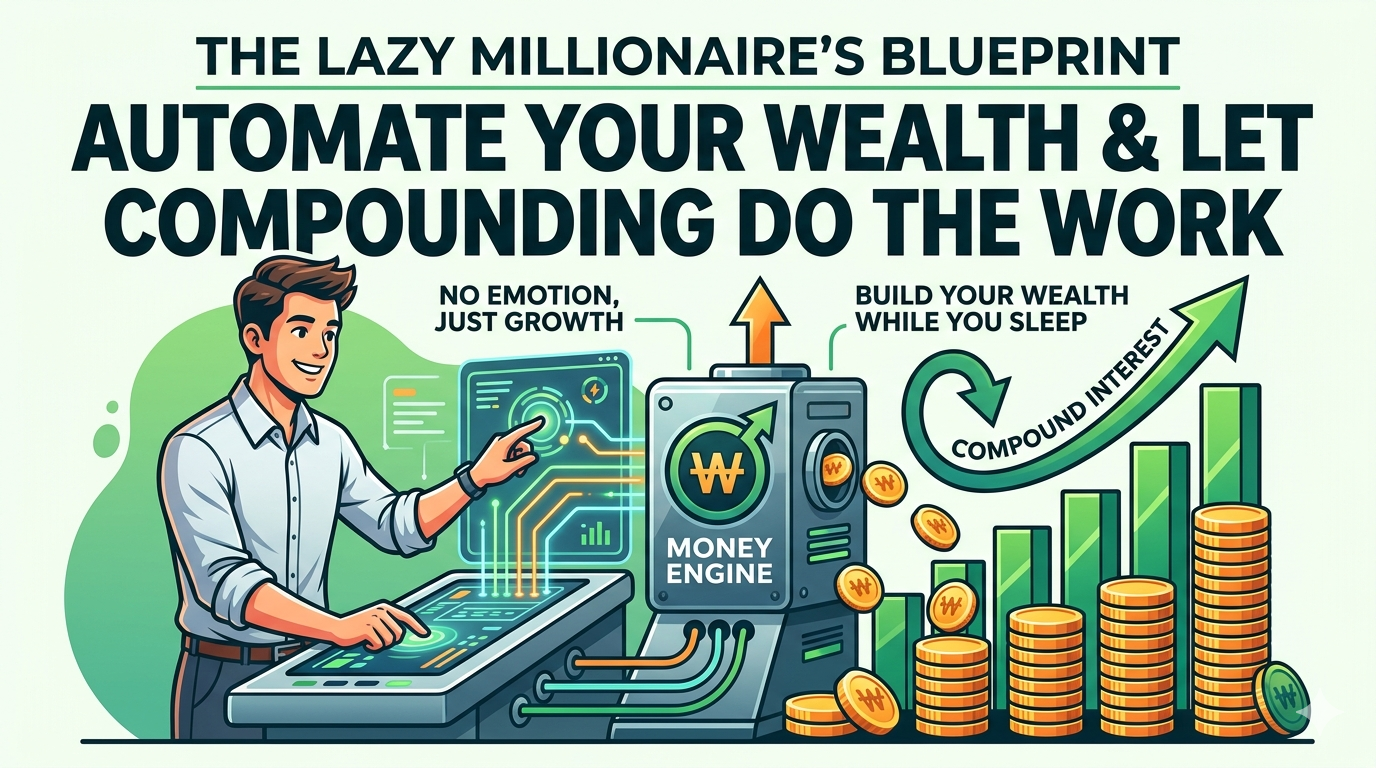
The Lazy Millionaire Blueprint: How to Build an Automated Investment System That Multiplies Your Money While You Sleep
Summary of the Article
This comprehensive guide provides a blueprint for young professionals to build a hands-free, automated investment system leveraging the power of compound interest. By integrating the “Pay Yourself First” principle with automated asset allocation, dollar-cost averaging (DCA), and tax-advantaged accounts, readers will learn how to remove emotion from investing and secure long-term wealth. Grounded in institutional data from Bloomberg and Vanguard, this step-by-step manual transforms financial anxiety into a systematic, high-yield wealth engine.
If you are relying on your monthly paycheck and a standard savings account to build wealth, you are financially running in place while inflation burns your purchasing power. The secret of the world’s wealthiest individuals isn’t that they work harder; it’s that their money works around the clock through the unstoppable engine of compounding interest. For young professionals entering the workforce, building a set-it-and-forget-it automated investment system is the single most powerful financial decision you will ever make—turning pocket change into a multi-million dollar fortress without lifting a finger.
Key Takeaways
- Automation Eliminates Emotion: Automating your investments removes human error, panic-selling, and the psychological friction of saving.
- The Power of Compound Interest: Starting in your 20s vs. your 30s can result in a difference of hundreds of thousands of dollars by retirement due to exponential growth.
- Tax-Advantaged Vehicles First: Maximize vehicle matching (401k, IRA) before moving to taxable brokerage accounts to protect your gains from the IRS.
- Low-Cost Index Funds Win: Over a 15-year horizon, low-cost index funds tracking the S&P 500 or total stock market consistently outperform actively managed funds.
1. The Psychology of Automation: Outsmarting Your Own Brain
The greatest enemy of a young investor is not a market crash; it is the reflection in the mirror. Behavioral economics shows that humans are hardwired to make poor financial choices. We suffer from loss aversion (the pain of losing $1,000 hurts twice as much as the joy of making $1,000) and present bias (valuing a weekend trip today over a comfortable retirement thirty years from now).
According to data compiled by Bloomberg Intelligence, retail investors who manually execute trades tend to underperform the broader market by an average of 3.5% annually. Why? Because they buy at the peak due to FOMO (Fear of Missing Out) and sell at the bottom during a market panic.
By building an Automated Investment System, you implement a financial philosophy known as “Paying Yourself First.” Instead of investing what is left after spending, you automatically route a percentage of your paycheck directly into investment vehicles the moment it hits your account. You never see the money, so you never miss it. You effectively eliminate decision fatigue and emotional vulnerability from your wealth-building journey.
2. The Mechanics of Compound Interest: Why Time Trumps Capital
To understand why an automated system must be built now, we need to look at the mathematics of compounding. Compound interest is the process where your investment earns interest, and then that accumulated interest earns interest on itself. It is a snowball rolling down a mountain.
Let’s look at a concrete mathematical comparison between two young professionals: Investor A (Early Starter) and Investor B (Late Starter).
- Investor A: Starts at age 22. Contributes $500 a month for just 10 years, then stops entirely at age 32. She lets the money compound at an average annual return of 8% until retirement at age 62.
- Investor B: Starts at age 32. Contributes $500 a month consistently for 30 years until retirement at age 62.
| Metric | Investor A (Early Starter) | Investor B (Late Starter) |
| Active Contribution Years | 10 Years (Age 22–32) | 30 Years (Age 32–62) |
| Total Principal Invested | $60,000 | $180,000 |
| Total Value at Age 62 | $612,403 | $540,830 |
| Net Wealth Advantage | +$71,573 | $0 |
Despite investing three times less money ($60,000 vs. $180,000), Investor A finishes with over $71,000 more than Investor B simply because she gave her money an extra 10-year runway to compound. For young professionals, time is a leverage factor far more valuable than the size of your initial paycheck.
3. Step-by-Step Blueprint to Constructing Your Automated Wealth Engine
Building this system requires a one-time setup that takes roughly two hours. Once active, it requires less than 15 minutes of annual maintenance.
[ Your Monthly Paycheck ]
           │
           ├──► [ Step 1: Emergency Fund (High-Yield Savings Account) ]
           │
           ├──► [ Step 2: Employer 401(k) Match (Instant 100% ROI) ]
           │
           ├──► [ Step 3: Roth IRA / Traditional IRA (Tax Shield) ]
           │
           └──► [ Step 4: Taxable Brokerage Account (Low-Cost Index Funds) ]
Step 1: Establish the Liquidity Buffer (The Emergency Fund)
Before a single dollar goes into the stock market, you must secure your financial foundation. Without a buffer, an unexpected medical bill or car repair will force you to liquidate your investments during a market downturn, locking in permanent losses.
- The Target: 3 to 6 months of baseline living expenses.
- The Vehicle: A High-Yield Savings Account (HYSA). Do not leave this money in a traditional brick-and-mortar bank earning 0.01%. Opt for digital banking institutions offering competitive rates to mitigate the corrosive effects of inflation.
Step 2: Capture the “Free Money” (Employer 401k Match)
If your company offers a 401(k) or 403(b) match, this is your highest financial priority. If your employer matches 100% of your contributions up to 4% of your salary, that is an instant, guaranteed 100% return on your investment. No stock, crypto, or real estate deal on earth can guarantee a 100% return on day one. Set your workplace retirement portal to automatically deduct this percentage from your gross paycheck.
Step 3: Weaponize the Tax Shield (Roth IRA vs. Traditional IRA)
Once the employer match is secured, redirect subsequent funds into an Individual Retirement Account (IRA).
- Roth IRA: You contribute after-tax dollars today, but your investments grow 100% tax-free, and your withdrawals in retirement are completely tax-free. For young professionals currently in a lower tax bracket than they will be in the future, the Roth IRA is an absolute superpower.
- Traditional IRA: Contributions are tax-deductible today, lowering your current taxable income, but you pay ordinary income tax upon withdrawal.
Step 4: Spillover into a Taxable Brokerage Account
If you have maximized your annual retirement account limits and still have capital left to deploy, open a taxable brokerage account with low-cost brokerages like Vanguard, Fidelity, or Charles Schwab. This money is highly liquid and can be accessed before retirement age without penalties, making it ideal for mid-term goals (e.g., buying a home in 7–10 years).
4. What to Buy: The “All-Weather” Low-Cost Portfolio Strategy
Setting up the accounts is only half the battle; you must select the assets. Wall Street wants you to believe that picking individual stocks is the key to wealth. However, long-term empirical studies published by organizations like Vanguard Research show that 92% of professional, institutional fund managers fail to beat the S&P 500 index over a 15-year period after accounting for fees.
If the professionals with supercomputers cannot consistently beat the market average, you shouldn’t try to either. Instead, buy the entire market through Low-Cost Index Funds or ETFs (Exchange-Traded Funds).
The Core Asset Pillars
- Total US Stock Market Index (e.g., VTI or VOO): Captures the growth of the largest companies in the United States (Apple, Microsoft, Amazon, etc.).
- Total International Stock Market Index (e.g., VXUS): Provides geographic diversification across European, Asian, and emerging markets, protecting you from a domestic downturn.
- Total Bond Market Index (e.g., BND): Provides stability and income. For young professionals with a multi-decade horizon, your bond allocation should be minimal (0% to 10%), as your primary objective is aggressive capital appreciation.
The Optimal Three-Fund Portfolio Allocation for Young Professionals
| Asset Class | Target Allocation | Sample ETF Ticker | Expense Ratio | Role in Portfolio |
| US Large & Mid-Cap Equities | 70% | VOO / ITOT | ~0.03% | Primary Engine for Growth & Compounding |
| International Developed/Emerging | 20% | VXUS / IXUS | ~0.07% | Geopolitical & Currency Diversification |
| US Aggregated Bonds | 10% | BND / AGG | ~0.03% | Volatility Mitigation & Liquidity |
Note: The Expense Ratio is critical. A high fee (e.g., 1.0% annual management fee) can siphon away up to 20% to 30% of your total lifetime portfolio value through lost compounding capacity. Stick to funds with expense ratios under 0.10%.
5. The Golden Rules of Maintaining Your Automation Matrix
Once your pipeline is mapped out—from your paycheck to your HYSA, 401(k), IRA, and Brokerage—you must adhere to two non-negotiable operational principles.
Rule A: Embrace Dollar-Cost Averaging (DCA)
By automating your investments on a fixed schedule (e.g., $250 every Friday), you execute a strategy called Dollar-Cost Averaging.
- When the stock market is at an all-time high, your fixed dollar amount buys fewer shares.
- When the market crashes and prices drop, your fixed dollar amount automatically buys more shares on sale.
You no longer need to worry about whether the market is up or down today. You welcome volatility because it allows your automated system to acquire assets at a discount.
Rule B: Implement Lifestyle Creep Automation
As a young professional, your income will scale over the next decade through promotions, job hops, and bonuses. The greatest threat to your wealth during this phase is lifestyle creep—the tendency to increase your spending at the exact same rate as your income increases (buying a more expensive car, renting a luxury apartment).
To neutralize this, commit to an Income Escalator Rule: Every time you receive a salary raise, immediately log into your automated portal and route 50% of the net increase directly into your investment pipeline. If you get a $500 monthly raise, increase your investments by $250 and use the remaining $250 to enjoy your life. You get to celebrate your career advancement while simultaneously accelerating your timeline to financial independence.
Conclusion: Take Action Within the Next 24 Hours
Wealth is not an accident; it is the natural byproduct of a well-engineered financial system. Relying on willpower to save money every month is a losing strategy. By automating your investments, you remove human weakness from the equation and let the mathematical law of compound interest do the heavy lifting.
The version of you that retires thirty years from now is relying entirely on the decisions you make today. Do not wait for the “perfect time” to invest. The perfect time was ten years ago; the second best time is today.
Your Immediate Next Steps:
- Log into your employer portal and verify you are contributing enough to capture the maximum 401(k) match.
- Open a Roth IRA with a low-cost, reputable custodian.
- Set up a recurring, automatic bank transfer from your checking account to your investment account to occur the morning after every payday.
Turn the system on, step away, and let time build your empire.